Build
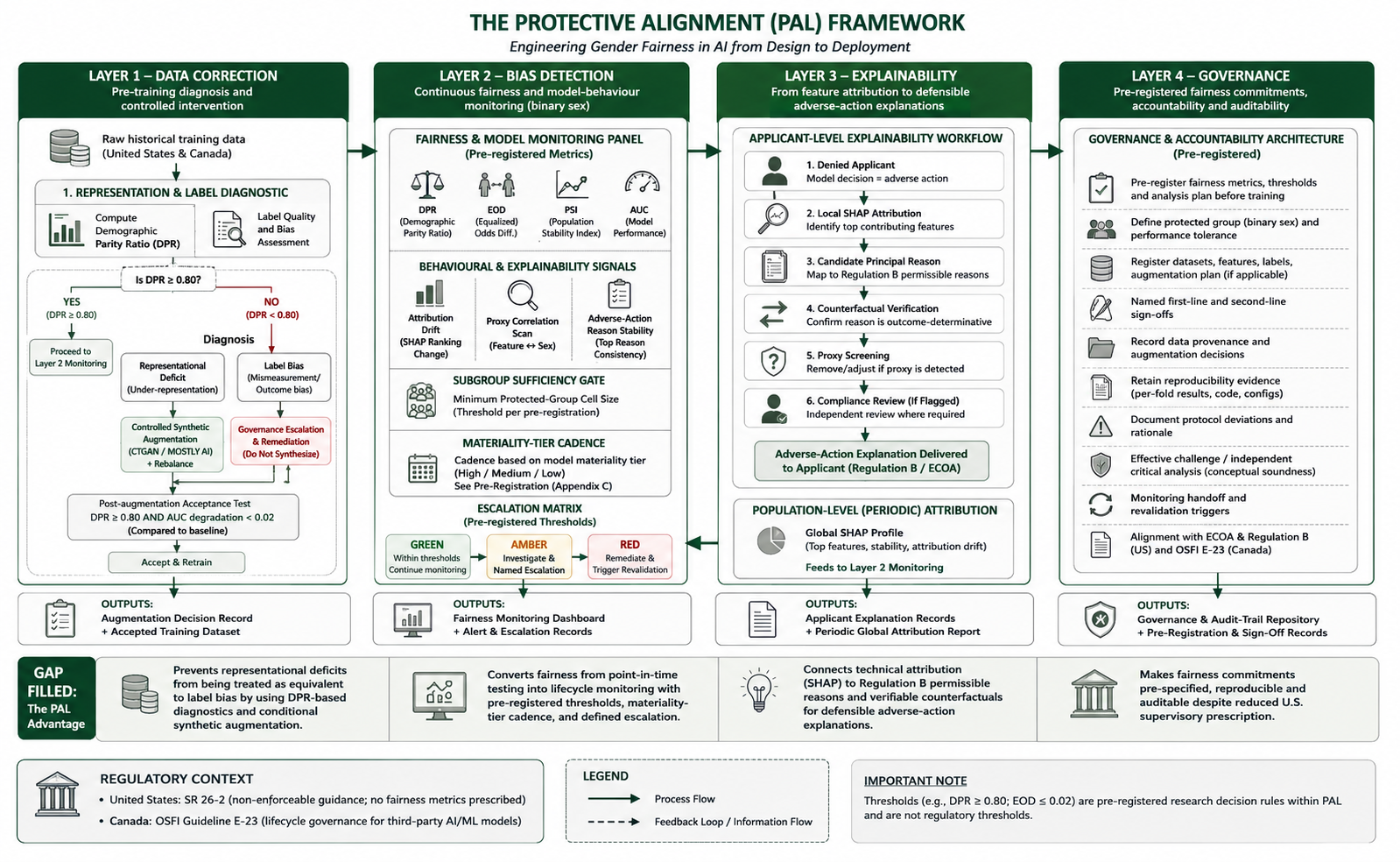
Create the four-layer governance architecture for gender-equitable credit outcomes.
The research
A practitioner validation study led by Alexandria Davis, Doctor of Business Administration candidate at Golden Gate University Worldwide.
Research aim
The study examines gender disparity in AI-enabled credit decisioning in the United States and Canada. It proposes PAL as a connected architecture for correcting data, detecting disparate outcomes, explaining decisions, and governing the evidence across the model lifecycle.
The quantitative research tests PAL against pre-registered fairness and performance rules. This questionnaire adds applied validation: whether experienced practitioners judge the accompanying tools relevant, feasible, proportionate, and defensible inside real institutional workflows.
Create the four-layer governance architecture for gender-equitable credit outcomes.
Test the layers against defined fairness, predictive performance, and regulatory sufficiency rules.
Turn findings into practical workflows, audit tools, and model risk management hooks.
Framework overview
Adults with current or past responsibility for model risk management, model validation, fair lending compliance, credit AI governance, model development, audit, or related oversight at financial institutions operating in the United States or Canada.
One anonymous online questionnaire lasting approximately 15–20 minutes. You will review four proposed governance tools and assess their relevance and feasibility. There are no right or wrong answers.
No name, email, employer name, IP address, or direct identifier is collected. Institutional details use broad categories. Responses are access-controlled and reported in aggregate; open text is reviewed before quotation for identifying details.
You may decline any question or leave before submission. Once an anonymous response is submitted, it cannot be identified and therefore cannot be withdrawn. Risks are minimal; avoid proprietary or confidential information.
Contribute
Review the tools first, then assess how they fit the realities of model development, validation, compliance, and governance.